
The online furniture market is growing fast, projected to hit $208 billion globally by 2028 (Statista, 2023). But for smaller furniture retailers, the challenge isn’t competing with big-box return policies or free shipping—it’s convincing customers to buy confidently online without ever stepping foot in a showroom.
If you’re running a business under $5 million in annual revenue, your north star metrics aren’t about return rates—they’re about conversions, average order value, and keeping merchandising costs under control.
The good news? A wave of new, affordable tools—backed by research and proven case studies—can help you compete head-to-head with much bigger brands. Below are five tactics that build buyer confidence, boost sales, and cut overhead, with examples from real retailers and research.
1. Augmented Reality to Build Buying Confidence
Furniture is one of the hardest things to buy online. Customers struggle to picture how a sofa or table will look in their space, and uncertainty kills sales.
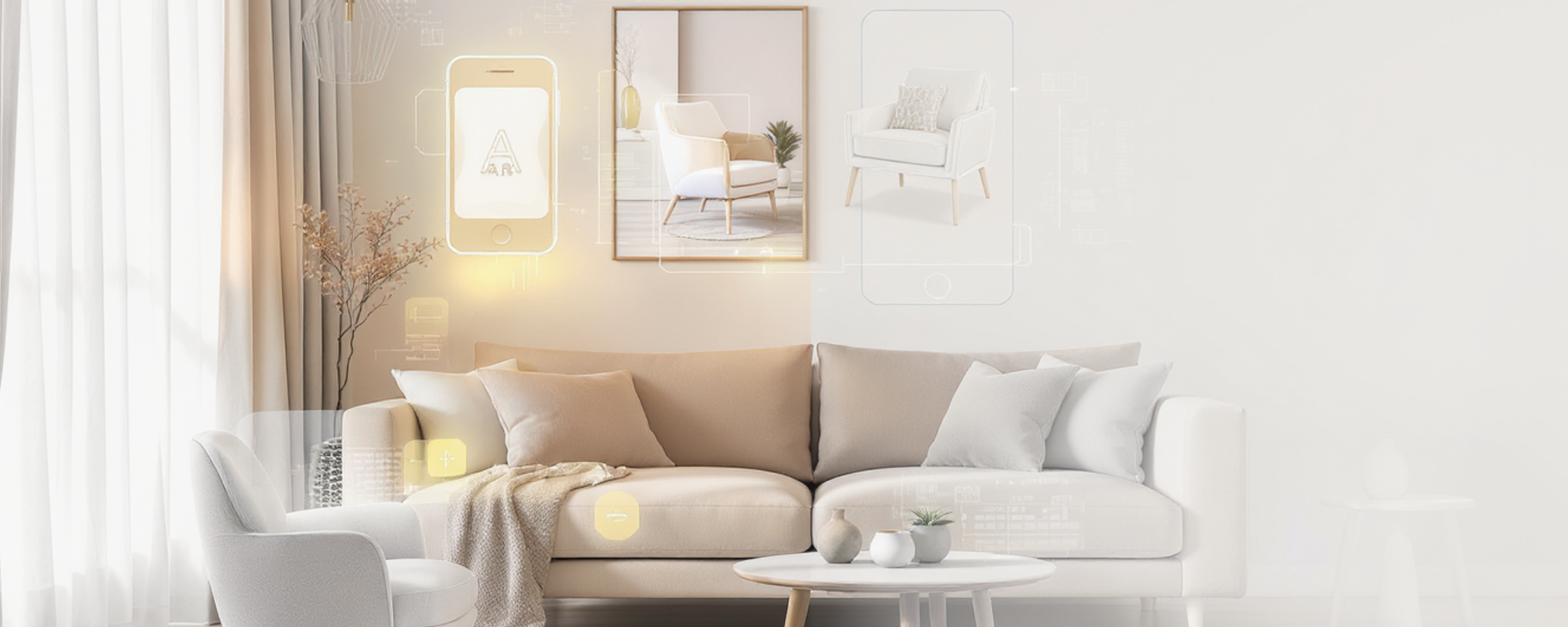
That’s where Augmented Reality (AR) comes in. Research from the Journal of Retailing & Consumer Services (2023) shows that true-to-scale AR previews increase purchase intent by 19%. Customers who can place a 3D model of a sofa in their living room feel safer hitting “buy now.”
Big retailers like Macy’s saw sofa returns drop when they rolled out AR—but for smaller businesses, the key benefit is closing more sales in the first place.
💡 Tip for smaller brands: Use web-based AR (no app required). Studies show requiring a download cuts adoption nearly in half (Deloitte, 2023). Tools like Polymuse’s AR viewer are browser-ready and lightweight, meaning your customers can preview products instantly.
2. Interactive 3D Configurators to Boost Average Order Value
For many shoppers, the appeal of furniture is personalization—choosing the right fabric, finish, or sectional layout. When customers can explore these options themselves, they not only stay longer on your site but also spend more.
A study by the University of Cambridge found that shoppers who configure their own product show an “ownership effect” almost 1.7× stronger than passive browsers, leading to 15–40% higher order values.
For example, DFS (UK) launched a sectional sofa configurator and saw a 112% jump in conversion rate and a 106% lift in revenue per session among users who interacted with it for more than 60 seconds.
➡️ With Polymuse’s 3D Configurator, even smaller retailers can give shoppers this experience. Customers can swap fabrics, resize modules, and preview the exact sofa setup they want—without the retailer holding inventory for every combination. It’s a practical way to increase upsells and reduce indecision.
3. AI-Generated Lifestyle Imagery to Cut Costs
High-quality lifestyle photography sells furniture—but it’s expensive. A typical photoshoot costs $1,800–$3,200 per SKU and takes up to 10 days (Home Furnishings Association, 2024). For a growing brand with dozens of SKUs, that’s a massive bottleneck.
AI now offers a smarter alternative. According to a 2024 MIT-IBM Watson study, AI-generated lifestyle images achieve 87% similarity to real photos when evaluated by human raters. And instead of thousands of dollars, they cost under $12 per image and take minutes, not days.
➡️ Polymuse’s AI Studio lets retailers upload CAD files and generate multi-angle lifestyle shots instantly. No set design, no lighting worries, no expensive reshoots. For smaller furniture brands, this levels the playing field with bigger competitors who have professional photography budgets.
4. 360° 3D Viewers to Keep Shoppers Engaged
Static images can only show so much. Customers want to see the stitching, the wood grain, and how a chair looks from the side or back. That’s why 360° 3D viewers are becoming standard in online furniture retail.
The Nielsen Norman Group found that interactive 3D models capture 32% more visual attention and extend average time on page to 2 minutes 47 seconds, compared to just 1 minute 4 seconds for static photos. And Shopify data shows that longer engagement translates into a 27% increase in add-to-cart events.
➡️ Polymuse’s WebGL viewer is optimized for smaller retailers: it loads in under 1.5 seconds on 4G and allows clickable hotspots for details like fabric care, dimensions, or leg height. This keeps customers engaged while answering questions that might otherwise block a sale.
5. Post-Purchase Photo Reviews to Build Trust
Even if you don’t accept returns, post-purchase engagement is still key. Customers who share photos of furniture in their homes provide authentic content that helps the next shopper feel confident buying from you.
A Journal of Service Research study (2022) found that asking for photo reviews can increase trust and lower hesitation, leading to 10–12% fewer customer complaints. On top of that, photo reviews drive 3.5× higher click-through rates than text-only reviews.
💡 Action step: Send an automated email asking buyers to upload a photo of their purchase. These user-generated photos double as free lifestyle imagery, which you can reuse in marketing campaigns and product pages.
Key Takeaway: Compete on Confidence and Conversion
For independent and mid-sized furniture retailers, the challenge isn’t handling costly returns—it’s winning customer trust online. Shoppers want reassurance that the piece they buy will fit their space, match their style, and meet their expectations.
That’s why tools like AR previews, 3D configurators, AI lifestyle imagery, and 360° viewers are no longer “nice-to-have”—they’re the conversion drivers that level the playing field.
Businesses that adopt these tactics don’t just look more modern; they see measurable results: higher conversions, bigger average carts, and lower merchandising costs. In fact, research from BCG (2024) shows that brands implementing these solutions typically see 18–30% profit growth per SKU within two quarters.
For smaller retailers, the two metrics to track are:
- ✓Conversion per session (turn more traffic into sales)
- ✓Merchandising cost per SKU (keep content affordable as you scale)
By adopting Polymuse’s suite of AR, AI, and 3D solutions, furniture brands under $5M revenue can offer enterprise-grade digital experiences—without enterprise budgets.