
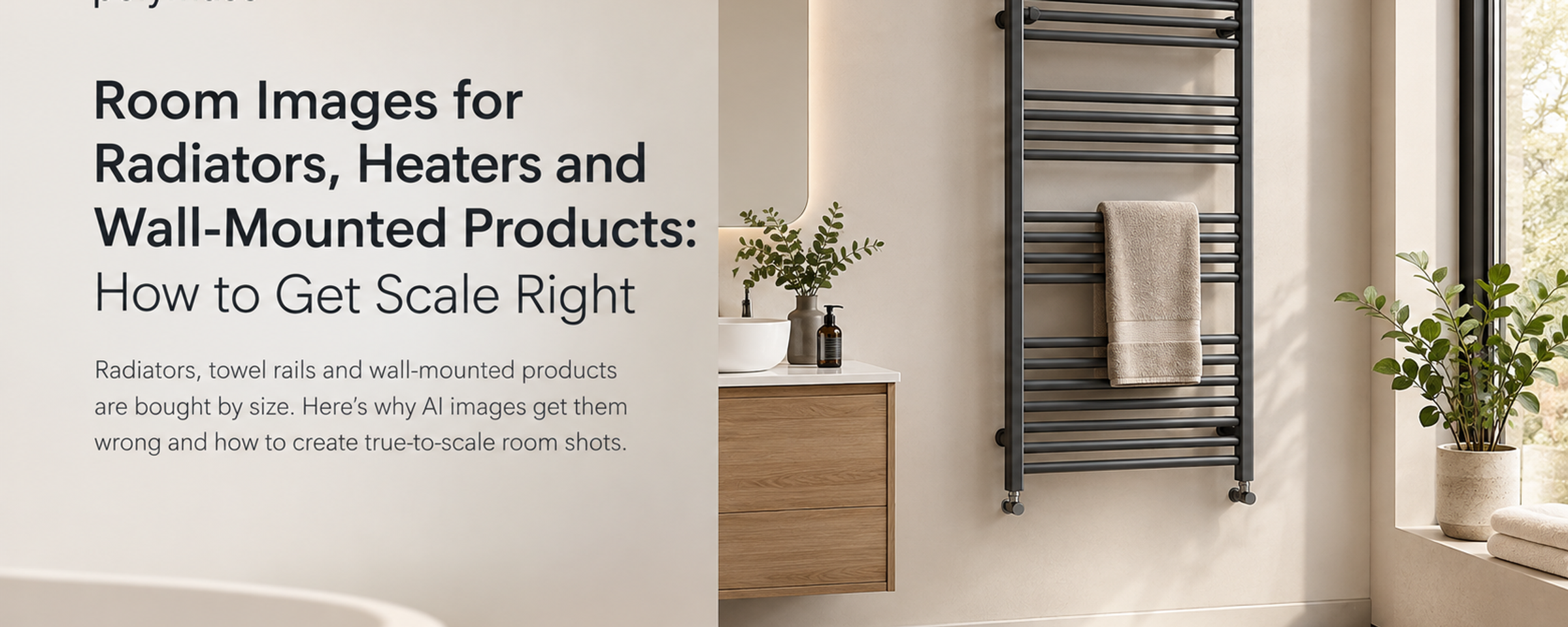
Some products forgive a bad image. A cushion that looks a bit larger than life still sells.
Radiators don't. Neither do towel rails, electric fires, wall lights, mirrors, vanities or wall panels. Buyers choose these by the numbers: height under the window sill, width between two doors, pipe centres, projection from the wall. The room image is often where they check whether it will fit.
So when an AI tool makes a 600 mm radiator look like 900 mm, it isn't a small cosmetic flaw. It's the wrong product.
Why wall-mounted products are the hardest case for AI
Size is the purchase decision
With a sofa, style often comes first and size second. With a radiator, size, output and fit come first. A shopper holding a tape measure will compare your image with their wall.
They sit on a plane, not a floor
Generators are better at putting objects on floors than on walls. Wall-mounted products have to line up with the wall's perspective, sit at a believable height and leave the right gap to the floor, sill and skirting. Small errors look obviously wrong.
Repeating elements get miscounted
Column radiators, fins, rails and slats are repeated patterns, and image models often get the count wrong. A 20-column radiator comes back with 17, or 24. That changes the width and the heat output buyers are reading about.
Metal and lacquer finishes reflect the room
Chrome, brushed steel, anthracite and gloss colours all pick up the surrounding light. If that light is invented, the finish looks wrong or fake.
Product photos are often shot at an angle
Many radiator photos are three-quarter shots to show depth. When AI needs a straight-on view for a room scene, it has to make up the geometry it never saw. That's where you get warped edges and blurred detail.
Even real estate AI staging struggles here. One homebuyer complained that AI-staged listing photos simply removed the radiators. If AI can't keep a radiator that's already in the photo, it won't reliably add yours at the correct size.
What a correct radiator room image needs
Use this as a brief for any image, whoever makes it:
- ✓Correct height: matches the product's real height against known references like a door, window sill or light switch.
- ✓Correct width: column or panel count matches the SKU shown.
- ✓Believable mounting: sensible gap to the floor and to the sill, flush and parallel to the wall.
- ✓Right projection: depth from the wall looks true, and the side profile matches.
- ✓Pipework and valves: placed where a real installation would put them, or left out cleanly. Never invented.
- ✓Finish accuracy: colour and sheen match a real sample.
- ✓Matched light: reflections and shadows come from the room's real light sources.
How to create these images without guessing
The reliable approach is the one CGI studios use, minus building the room from scratch. Keep the product as an accurate 3D model, give the room a 3D understanding, and only let AI handle the lighting.
That's what Staging Studio does:
- Pick any background. Use a showroom photo, an installer's job photo, a customer's room or a stock interior.
- AI maps the room in 3D. It finds the floor, walls and camera perspective.
- Place your radiator. Drag the 3D model onto the wall. It sits flush against the wall plane at its real dimensions, and you can move it under the window, beside the door or into an alcove.
- Relight with one click. AI matches the lighting, reflections on the finish and shadow on the wall. The product itself isn't regenerated, so column count, valves and profile stay exactly as designed.
Need the same room with a different height, colour or column count? Swap the model or its variant and relight. Nothing gets reshot or rebuilt.
Uses beyond the product page
- ✓Range pages: show a family of sizes in one consistent room so buyers can compare.
- ✓Colour and finish selectors: the same room in white, anthracite, brass or chrome.
- ✓Trade and specifiers: stage a model into an architect's or interior designer's own photo during a pitch.
- ✓Installer and dealer marketing: give partners accurate, on-brand images of every SKU.
- ✓Customer quotes: stage the chosen model into the buyer's own room photo before they order. This reduces "it looked bigger online" returns.
Other products with the same problem
Radiators are a clear example, but anything bought by size, mounting position or exact detail has the same issue:
- ✓Towel rails and bathroom heaters
- ✓Electric fires, stoves and fireplaces
- ✓Wall lights, pendants and mirrors
- ✓Bathroom vanities, basins and shower screens
- ✓Kitchen appliances and range cookers
- ✓Doors, wall panels and acoustic panels
- ✓Blinds and shutters (see our blinds and shades configurator)
- ✓Saunas, hot tubs and outdoor equipment (see our sauna and hot tub configurator)
- ✓Cabinets, wardrobes and shelving (see our closet and cabinet configurator)
If your buyers are measuring before they buy, your images have to be to scale.
FAQ
Can AI tools like ChatGPT or Gemini place my radiator in a room accurately? They can make convincing images, but they don't know the real size of your product or the room, so scale and details are guessed. For products bought by size, the risk of a misleading image is high. Use a 3D model of the product with AI lighting instead.
What if I only have photos of my radiators, not 3D models? Polymuse can create 3D models from CAD files, product drawings, photos or scans. Radiators and other geometric products are usually quick to model accurately from technical drawings.
Can I show different sizes of the same radiator in one room? Yes. Keep the same background, swap in the model for each size, and relight. Every size stays in true proportion to the room.
Will the finish look realistic? The relighting step matches reflections and shadows to the room, which matters most for metallic and gloss finishes. Always check the result against a physical sample for colour-critical finishes.
Is this only for radiators? No. It works for any product, but it adds the most value for wall-mounted and size-critical items where AI image errors are most visible.
Selling radiators, heaters or wall-mounted products?
We'll stage one of your models into a real room at true scale.