
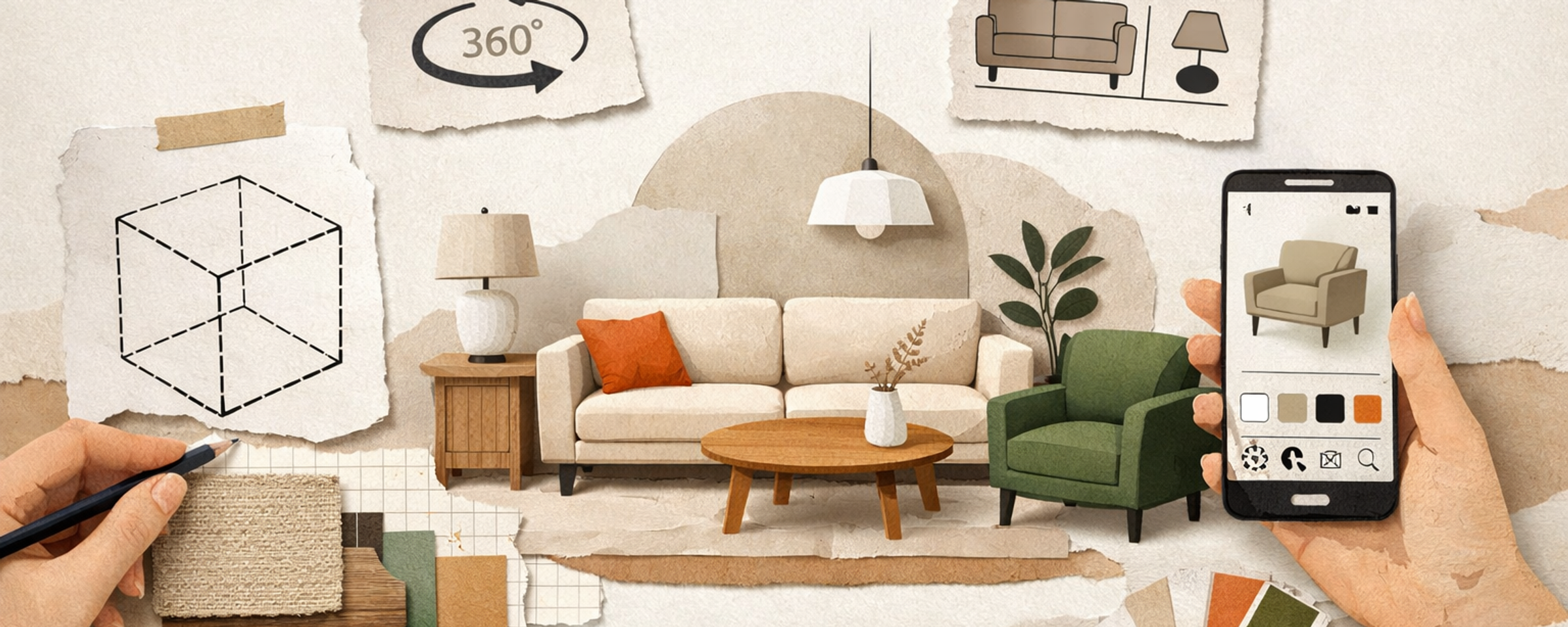
Selling furniture—whether to a consumer, an interior designer, or a corporate procurement team—has moved far beyond flat, static images. Today's buyers want to interact, configure, and visualize products in their own space before making a commitment. To meet this demand, brands need a robust furniture visualization platform.
But with so many options on the market, how do you choose the right one? The best furniture visualization software does more than just display a 3D model; it streamlines your entire marketing, sales, and content creation pipeline.
Whether you are upgrading your current tech stack or adopting 3D for the first time, here are the seven essential features to look for when choosing a furniture visualization platform.
1. A High-Performance 3D Configurator
When you sell modular furniture or items with dozens of fabric, finish, and hardware options, standard photography simply cannot keep up. A 3D configurator is vital for showcasing every possible variant of your furniture without requiring a massive photo shoot for each combination.
However, not all configurators are created equal. A top-tier configurator must be intuitive, load quickly, and handle complex logic (e.g., if a user selects a specific armrest, only compatible cushions should be displayed).
For a deep dive into the technical must-haves, check out our detailed guide on what to get right when adding a 3D configurator to your e-commerce store.
Looking for a place to start? The Polymuse 3D Configurator is designed to handle complex modular logic with ease. (Stay tuned for our upcoming list of the top 3D configurators on the market!)
2. 3D Viewer and "Try Before You Buy" (AR)
Switching to interactive 3D significantly improves customer engagement across the board:
- ✓For B2B: Interior designers, architects, and procurement teams gain immediate confidence in the product, leading to heightened interest and a dramatically shorter sales cycle.
- ✓For B2C E-commerce: Customers spend far more time on your website interacting with the product, which directly translates to higher conversion rates and fewer returns.
- ✓For Retailers: Design services become infinitely more relatable when sales reps can project a life-sized sofa directly into the customer's living room using Augmented Reality (AR).
Best Practices for a 3D Viewer:
When evaluating a furniture visualization app or web viewer, speed is paramount. Customers will bounce if a model takes ten seconds to load. However, this speed should never force you to compromise on visual quality. Furthermore, the viewer should be highly customizable to match your brand's unique "vibe" and include the ability to add interactive hotspots that highlight key product features and craftsmanship.
3. An AI Studio for Lifestyle Photo and Video Generation
Traditionally, creating lifestyle marketing content and Product Detail Page (PDP) photos took weeks. Brands had to rent photo studios, hire expensive photographers, ship heavy furniture, and spend thousands on gear.
Then came traditional 3D rendering. It solved the travel and logistics problems, but it still cost hundreds of dollars per shot and took weeks of back-and-forth with 3D artists.
Enter the AI evolution. What used to take weeks now takes minutes. A modern furniture visualization platform must include an AI Studio to make 3D rendering faster, cheaper, and vastly superior.
Things your AI Studio must have:
- ✓Precise Changes: The AI must generate stunning backgrounds while keeping the structural quality and integrity of your original 3D furniture model 100% intact.
- ✓Prompt Templates: Predefined, savable prompts so your team doesn’t have to type out lighting and room descriptions every single time.
- ✓High-Resolution Support: Export capabilities ranging from 1K up to crisp 4K imagery.
- ✓Multi-Platform Aspect Ratios: Instant generation for Instagram Reels (9:16), web banners (16:9), and standard product feeds (1:1).
- ✓Advanced Editing (Inpainting): The ability to edit, add, or remove items from a specific area of the generated image.
- ✓Set Creation: Easily generate cohesive scenes, like a matching dining table and chairs.
- ✓Upholstery Swapping: Keep the entire room and lighting unchanged while instantly swapping the fabric on a sofa.
- ✓Video Generation: The ability to generate and seamlessly extend compelling lifestyle videos of your products.
4. Automated Spec Sheet Generation
When you have an accurate 3D model, generating product data should be easy. Yet, teams often spend hours manually laying out PDF spec sheets for B2B clients and retail partners.
A comprehensive visualization platform automates this. Look for a system that leverages AI to instantly generate accurate, beautifully branded PDF spec sheets directly from your 3D data. The ability to do this in bulk saves massive amounts of administrative time and ensures your sales teams always have up-to-date collateral.
5. Streamlined 3D Model Creation
Your 3D model is your single source of truth. However, creating these models from scratch can be costly and time-consuming. Even if you have an internal 3D team, spending hours modeling a brand-new design concept just for a "first pass" might not be worth the ROI.
Your chosen platform should offer pathways to create 3D models rapidly, whether through an automated AI pipeline or a managed manual creation service.
Key features for 3D asset creation:
- ✓Image-to-3D: The ability to generate a baseline 3D model simply from product sketches or reference photos. For instance, with Polymuse's Image-to-3D tool, you can simply upload a single photo of your furniture piece and get a fully realized 3D model almost immediately. This completely removes the barrier to entry for brands without an in-house 3D modeling team.
- ✓Clean Topology: AI-generated meshes must be clean and manageable so 3D artists can easily post-process them if needed.
- ✓PBR (Physically Based Rendering) System: Ensure you can easily swap realistic textures like velvet, leather, and wood grains.
- ✓Variable Quality Settings: Generate lightweight models for quick web viewing, or ultra-high-poly models for cinematic rendering.
(Note: If you already have physical prototypes, Photogrammetry apps—like the one offered by Polymuse—can quickly scan physical items into 3D. However, if you are designing from scratch, automated modeling tools are your best friend.)
6. Seamless Integration
The best furniture visualization software in the world is useless if it doesn't play nicely with your current tech stack. Ensure the platform you choose is easily embeddable into your existing website, headless architecture, or major e-commerce platforms like Shopify, WooCommerce, or Magento.
A crucial factor here is how the platform handles standard e-commerce limitations. For example, Shopify natively restricts products to a maximum of 3 options (e.g., Size, Color, Material) and 100 variants. A top-tier visualization platform circumvents these hard limits, providing support for unlimited options and variants. This is absolutely essential if you are selling highly configurable, modular furniture.
Furthermore, the integration should feature a streamlined checkout process that works natively with your storefront. When a customer finishes building their complex, custom piece in the configurator, adding it to the cart and checking out should feel frictionless and fully native to your site.
7. How to Choose the Right Tech Partner: Agility vs. Legacy
When choosing a software partner, brands often default to massive, decade-old legacy companies. However, selecting the right tech partner means evaluating how well they can adapt to your specific, evolving needs. For a modern brand, partnering with an agile, startup-minded team often yields far better results. Here is what you should look for in a tech partner's service model:
- True Agility: Need a specific feature? You can often speak directly to founders and decision-makers, resulting in immediate implementation rather than sitting in a support ticket queue for months.
- State-of-the-Art Innovation: Agile platforms are built on modern, state-of-the-art (SOTA) tech stacks—not patched-together code from ten years ago.
- Competitive Pricing: Startup platforms usually offer incredibly competitive pricing with no hidden implementation fees or bloated enterprise costs.
- Fast Product Pipelines: When a new AI or 3D technology drops, agile teams implement it in weeks, while big players take years to adapt.
- Self-Serve & No Vendor Lock-In: You want DIY solutions that empower your team to move fast without waiting on customer support. Most importantly, you should always own your 3D models, making it easy to switch platforms or use your assets wherever you see fit.
Conclusion: Checking All the Boxes with Polymuse
Finding a furniture visualization platform that beautifully renders 3D, offers seamless AR, powers AI lifestyle generation, and automates your sales collateral used to require piecing together five different expensive softwares.
Polymuse is built differently. We combine lightning-fast 3D configurators, a cutting-edge AI photography studio, automated spec sheet generation, and an agile, self-serve approach that gives you total ownership of your assets.
Ready to change how you visualize and sell furniture? Explore what Polymuse can do for your brand today.