
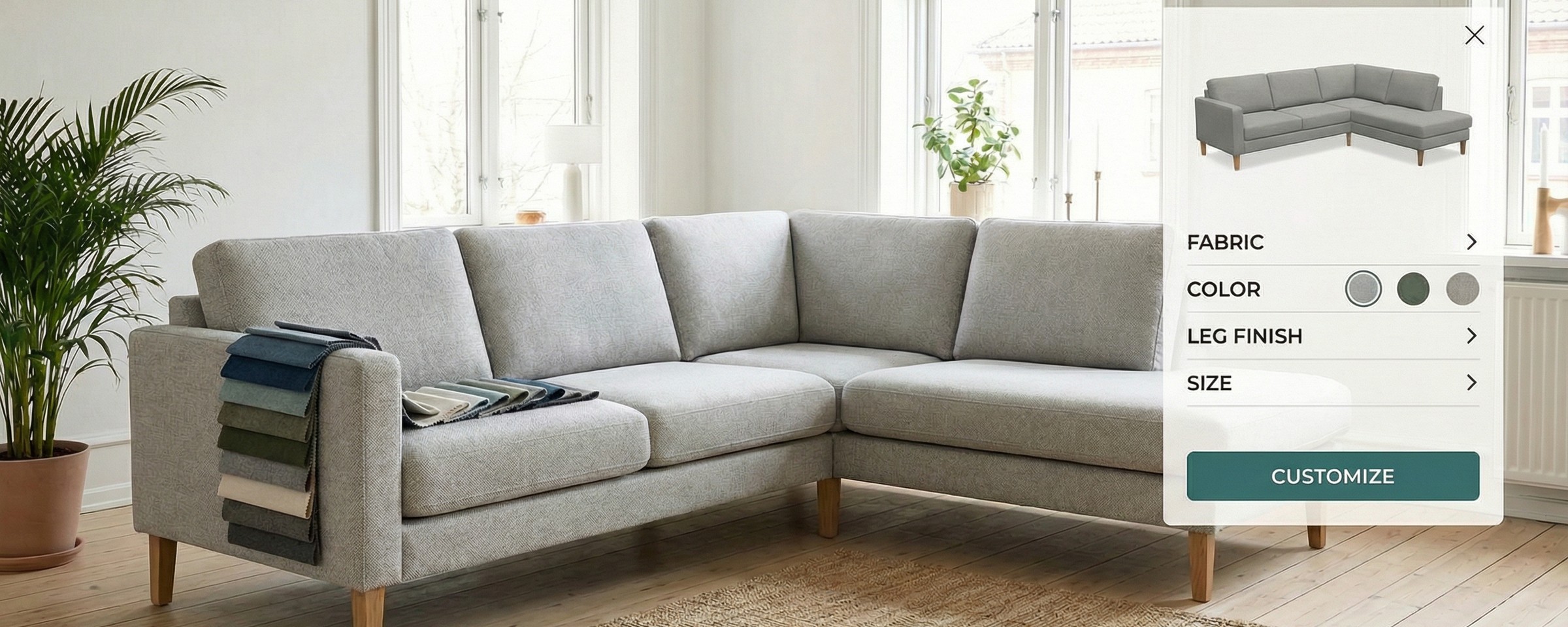
What is a 3D furniture configurator?
A 3D furniture configurator lets shoppers and sales reps change fabric, finish, size, legs and modules on a live 3D model of your product. Rules keep every choice valid, and the price updates with each change. Polymuse is furniture configurator software built for exactly this.
It suits brands that sell configurable or modular furniture: sofas and sectionals, tables, beds, storage and outdoor ranges, often with hundreds of fabrics. The finished design can carry into pricing, a quote, ecommerce and production data, so nobody has to re-key the order.
This guide covers how a 3D furniture configurator works, what it costs, and the eight steps to launch one with Polymuse.
See a 3D furniture configurator on your own product
Book a demo and see how your range would work in 3D.
Steps to Build a 3D Product Configurator for Furniture Brands with Polymuse
1. Define Furniture Brand Business Objectives
Before building a 3D configurator, it is important to clearly define what you want to achieve. Common goals include:
- ✓Increasing online sales conversions
- ✓Reducing product returns
- ✓Offering mass customization
- ✓Enhancing brand differentiation
Polymuse helps furniture brands align these objectives with a flexible 3D platform that supports both eCommerce and sales-led workflows.
Ready to modernize your catalog?
Join 500+ brands using our 3D engine.
2. Decide on Furniture Customization Options
Furniture customization is the core of a successful configurator. Determine which elements users can modify, such as:
- ✓Materials, including wood, fabric, and metal
- ✓Colors and finishes
- ✓Dimensions and layouts
- ✓Accessories or modular components
Well-structured configuration options keep the experience intuitive while still
offering meaningful personalization. Polymuse enables furniture brands to manage these variations efficiently without adding complexity for the end user.
3. Develop High-Quality and Optimized 3D Models
Accurate and optimized 3D models are critical. Furniture models should:
- ✓Match real-world proportions and textures
- ✓Be lightweight for fast loading
- ✓Support multiple configurations
Polymuse supports high-quality 3D visualization that balances visual realism with performance, ensuring smooth interaction across devices and browsers.
4. Choose the Right 3D Technology Stack
Selecting the right technology is essential for performance and scalability. Common choices include:
- ✓WebGL, the core browser technology for 3D rendering
- ✓Three.js, a framework that simplifies working with WebGL
- ✓Polymuse, a web-based platform that uses these technologies to deliver a complete 3D configurator solution
A web-based 3D configurator ensures accessibility without requiring users to download applications. Technologies built on modern browsers allow furniture brands to reach customers on desktop, tablet, and mobile devices.
Polymuse provides a scalable web-based 3D platform designed specifically for furniture visualization, making it easier to deploy and maintain configurators across large product catalogs.
5. Design a Simple and Intuitive User Interface
A successful 3D product configurator should be easy to use, even for non-technical users. Best practices include:
- ✓Simple configuration panels
- ✓Real-time visual updates
- ✓Smooth camera controls such as rotate, zoom, and pan
- ✓Clear pricing updates as users customize products
Polymuse focuses on clean interface design that highlights the product while keeping controls straightforward, improving user engagement and time spent on product pages.
6. Integrate with eCommerce and Sales Systems
To deliver real business value, the configurator must connect with key systems such as:
- ✓Product information management systems
- ✓Inventory and pricing systems
- ✓Shopping cart and checkout workflows
Polymuse supports integration with existing eCommerce platforms, including Shopify, and sales workflows. This enables configured furniture products to be ordered, saved, or shared without friction, allowing customers and sales teams to move seamlessly from configuration to purchase or quotation.
7. Optimize for Performance and SEO
Performance directly impacts user experience and search rankings. Key optimization steps include:
- ✓Compressing 3D assets
- ✓Implementing lazy loading
- ✓Ensuring mobile responsiveness
- ✓Using SEO-friendly URLs and metadata
Polymuse is built with performance optimization in mind, helping furniture brands deliver interactive 3D experiences that load quickly, perform smoothly, and support long-term organic visibility.
8. Test, Launch, and Continuously Improve
Before launch, test the configurator across devices and browsers. After launch, collect user feedback and monitor analytics such as:
- ✓Engagement time
- ✓Configuration completion rates
- ✓Conversion rates
Polymuse provides a strong foundation that allows furniture brands to iterate and expand their 3D experiences as product lines and customer expectations evolve.
What a 3D furniture configurator costs
Off-the-shelf SaaS configurators typically cost $199 to $2,000 per month. Mid-market and enterprise platforms run $15,000 to $150,000+ per year once 3D models, setup and integration are included. 3D models themselves usually cost $100 to $500 each.
Polymuse publishes its prices. The Configure plan is $199 per month, and the Modular plan, built for sectionals and modular ranges, is $499 per month, both billed annually. 3D modelling is scoped separately when you need it. Read the full cost breakdown or compare pricing.
Conclusion
A 3D product configurator has become a powerful tool for furniture brands looking to stand out in a competitive digital landscape. When built correctly, it enhances customer confidence, simplifies customization, and turns product exploration into a sales-driving experience.
Polymuse empowers furniture brands to achieve this without complexity. By offering a dedicated 3D platform tailored for furniture visualization, Polymuse helps brands showcase products accurately, manage customization efficiently, and deliver engaging online experiences at scale. For furniture brands aiming to modernize their digital presence and convert more confident buyers, Polymuse provides the technology and flexibility needed to move forward.